Have you ever written “loss” when you meant “lost”? You are not alone. Many people mix up these two words every day.
They look almost the same. But they work in very different ways.
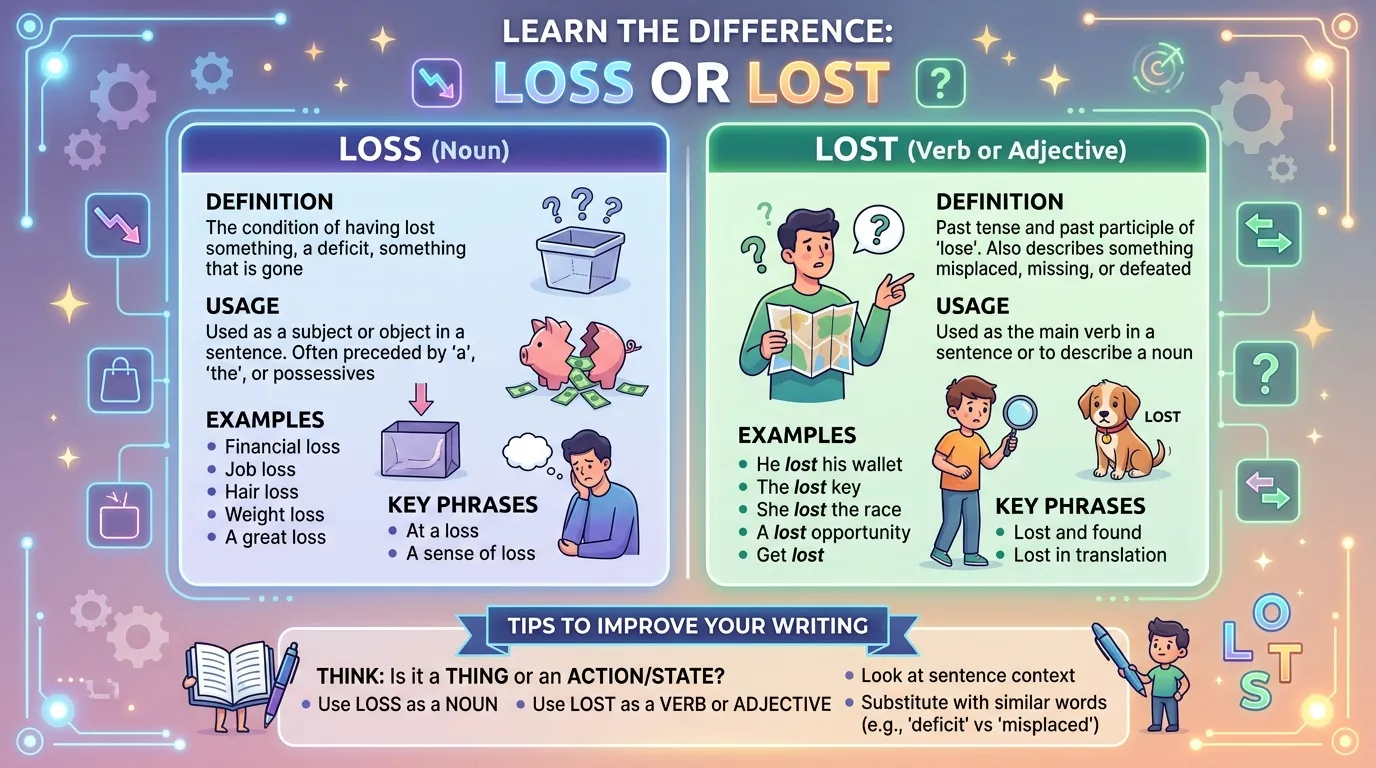
“Loss” is a noun. It names a thing or a feeling. “Lost” is a verb. It tells you what happened in the past. Writing the wrong one can make your sentence look wrong. It can also confuse your reader.
People search for “loss or lost” because they want a fast, clear answer. They need to know which word fits and why.
This guide gives you that answer. You will learn the difference in just a few minutes. No hard rules. No big words. Just simple and clear help.
Loss or Lost Quick Answer
Loss and lost are two different words. They look alike but work in different ways. Loss is a noun. That means it names a thing or feeling. Lost is a verb. It shows an action that happened in the past. You use loss when you talk about something that was taken away. You use lost when you say what someone did in the past.
Here are two simple examples. The team felt the pain of their loss. In this sentence, loss is the thing they felt. The team lost the game. Here, lost tells you what happened. The team played. They did not win. Many people mix up these two words. This guide will clear up the confusion fast.
The Origin of Loss or Lost
Both words come from very old English. The word loss comes from the Old English word los. It meant ruin or destruction. Over time, people used it to talk about anything that was taken away or gone. The word lost comes from leosan. This was an Old English verb. It meant to lose or to be without something.
Both words have the same root. That is why they look so much alike. But over hundreds of years, they grew into two separate words with two different jobs. One became a noun. One became a verb. This is why people still mix them up today.
British English vs American English Spelling
Good news: there is no spelling difference between British and American English for these two words. Both groups spell them the same way. Loss is loss in the UK and the US. Lost is lost in both places too.
The confusion is not about spelling rules from different countries. It is about grammar. People often use loss when they should use lost and the other way around. The table below shows how each word is used.
V
visualize
V
visualize show_widget
Which Spelling Should You Use?
The answer is simple. Ask yourself one question: is it a thing or an action? If you are naming a thing or a feeling, use loss. If you are saying what someone did in the past, use lost.
If you write in the US, the UK, Canada, or Australia, the rule is the same. There is no country where the rule changes. Use loss as a noun. Use lost as a verb. If you are writing for a global audience, this still applies. The rule does not change no matter where you are or who you write for.
Common Mistakes with Loss or Lost
Many people make these same errors. Knowing them will help you avoid them. One very common mistake is writing I had a big lost instead of I had a big loss. Here, the writer needs a noun. Lost is a verb. The correct word is loss.
Another mistake is writing She loss her job instead of She lost her job. The sentence needs a past-tense verb. Loss is a noun and does not work here. Some people also write a lost by accident. You can never put a before lost because lost is not a noun. Always put a or the before loss only. Keep these simple rules in mind and you will not make these errors.
Loss or Lost in Everyday Examples
Here is how both words appear in real life. In an email, you might write: We are sorry for the loss of your order. Please contact us for help. In the news, a headline might say: Team lost the final match by two points. On social media, someone might post: I lost my cat. Please help. In a formal letter, you might read: The company reported a net loss of ten million dollars this year.
You can also see these words in everyday speech. He lost his wallet on the train. The loss of a loved one is very hard. Both words are common and easy to use once you know the rule.
Loss or Lost Google Trends and Usage Data
Both words are searched all over the world. People search loss vs lost most often in countries where English is a second language. These include India, Pakistan, the Philippines, and Nigeria. But people in the US and UK also search for this topic.
The word lost is used more often in everyday writing. This is because it is a verb. Verbs appear in almost every sentence. Loss is used more in formal and business writing. Words like job loss, net loss, and profit and loss are very common in business. The phrase at a loss is also widely used. It means someone does not know what to do next.
V
visualize
V
visualize show_widget
FAQs
Is loss a noun or a verb?
Loss is a noun. It names a thing or a feeling. You cannot use it as a verb. You say the loss was hard not she loss the race.
Is lost a noun or a verb?
Lost is a verb. It is the past tense of lose. You use it to talk about something that happened in the past. He lost his phone is correct.
Can lost ever be an adjective?
Yes, it can. When you say a lost dog, lost describes the dog. It tells you the dog cannot find its way. In this case, lost is an adjective, not a verb.
What does at a loss mean?
At a loss is a common phrase. It means someone does not know what to do or say. For example, She was at a loss for words. This phrase uses loss as a noun.
What is the plural of loss?
The plural is losses. You say The team had three losses this season. You add es to make it plural.
Can I say a lost or the lost?
You cannot say a lost because lost is a verb, not a noun. But you can say the lost when it acts as an adjective before a noun, like the lost child. You can never say I had a lost.
What is the difference between job loss and lost a job?
Job loss uses loss as a noun. It names the event. Lost a job uses lost as a verb. It says what happened. Both are correct but used in different ways.
Conclusion
Loss and lost come from the same root. But they do very different jobs. Loss is a noun. Use it to name a thing or a feeling. Lost is a verb. Use it to tell what happened in the past. The spelling is the same in all countries. There is no British or American difference. The only rule is about grammar.
To avoid mistakes, ask one question before you write: Is this a thing or an action? If it is a thing, write loss. If it is an action in the past, write lost. Keep sentences short and simple. Read your work out loud. If it sounds wrong, it probably is. Both words are easy to use once you know this rule. Practice with simple sentences every day. You will get it right very soon.

I’m David Baldacci, a bestselling thriller author passionate about suspense, mystery, and unforgettable characters. Through Grammerliz.com, I share insights into my books, writing journey, popular series, and storytelling techniques. This platform connects readers with my latest releases, thrilling adventures, and the world of crime fiction that has inspired millions worldwide.