Python is one of the most popular coding languages in the world. Many people learn it because it is easy to read and simple to use.
But some small parts can confuse beginners. One of these is the or operator Python.
Many people search for this topic because they want to know when to use the or operator. They may also want to know why their code does not work. This operator is small, but it is very important.
The or operator helps a program make decisions. It checks two or more conditions. If at least one condition is true, Python gives a true result.
Many beginners make mistakes with this operator. They may write it the wrong way. They may also forget to repeat conditions. These mistakes can cause errors.
The good news is that the or operator is easy to learn. You only need a few simple rules.
This guide explains everything in easy words. You will learn what the or operator means, where it came from, how people use it, and how to avoid mistakes. You will also see examples, tables, and common questions.
By the end, you will know how to use the or operator with confidence.
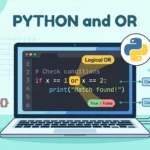
Or Operator Python Quick Answer
The or operator checks if one or more conditions are true.
If one condition is true, Python returns True.
If all conditions are false, Python returns False.
Example:
age = 20

if age > 18 or age == 18:
    print("You can enter.")
Output:
You can enter.Another example:
print(True or False)Output:
TrueThis happens because one value is true.
Here is a simple rule:
| Condition | Result |
|---|---|
| True or True | True |
| True or False | True |
| False or True | True |
| False or False | False |
The or operator helps make code short and easy to read.
The Origin of Or Operator Python
The word or is an old English word. People have used it for many years.
It means one thing, another thing, or both.
Computer science later used this word in logic systems. Programming languages then added it.
Python was created in 1991 by Guido van Rossum. He wanted Python to be easy to read.
Many coding languages use symbols like this:
||Python does not.
Python uses simple English words.
That is why Python uses:
orThere are no spelling differences.
The only mistake people make is using capital letters.
Correct:
orWrong:
OR
Or
Python only accepts lowercase letters.
British English vs American English Spelling
There is no spelling difference.
British English and American English both use or.
Python code stays the same everywhere.
| Topic | British English | American English | Python |
|---|---|---|---|
| Spelling | or | or | or |
| Meaning | Choice between items | Choice between items | Logical choice |
| Capital letters | Not needed | Not needed | Not allowed |
| Usage | Same | Same | Same |
Python has one standard rule.
Every country follows it.
Example:
True or FalseThis works in every country.
Which Spelling Should You Use?
Always use:
orUse lowercase letters only.
For US users
Use:
orUse:
For UK users
orFor global users
Use:
orPython never changes.
Do not use:
OR
Or
Python will show an error.
Keep your code simple.
Common Mistakes with Or Operator Python
Many beginners make small mistakes.
Mistake 1: Using capital letters
Wrong:
True OR FalseCorrect:
True or FalseMistake 2: Forgetting the second condition
Wrong:
if age > 18 or:Correct:
if age > 18 or age == 18:Mistake 3: Comparing values the wrong way
Wrong:
if color == "red" or "blue":Correct:
if color == "red" or color == "blue":Mistake 4: Using symbols from another language
Wrong:
||Correct:
orMistake 5: Adding extra spaces inside code
Wrong:
o rCorrect:
orAlways write full conditions.
This makes code easier to read.
Or Operator Python in Everyday Examples
People use the or operator every day.
Email Login
A website may ask:
“Use email or phone number.”
Python example:
if email or phone:
    print("Continue")
News Websites
A news website may show:
“Choose sports or business news.”
Python example:
if section == "sports" or section == "business":
    print("Open page")
Social Media
Users may log in with:
“Email or username.”
Python example:
if email or username:
    print("Login")
School Systems
Schools may ask:
“Choose online or classroom learning.”
Python example:
if mode == "online" or mode == "classroom":
    print("Approved")
Shopping Websites
A store may ask:
“Pay with a card or cash.”
Python example:
if payment == "card" or payment == "cash":
    print("Payment accepted")
The or operator is used in many real systems.
It helps programs make choices.
Or Operator Python – Google Trends & Usage Data
The keyword or operator Python is searched all over the world.
Many people search for it because Python is very popular.
Countries with high interest include:
- India
- Pakistan
- United States
- United Kingdom
- Canada
People search for it because:
- They are learning Python.
- They are building projects.
- They are preparing for exams.
- They are getting ready for coding interviews.
Students search for it the most.
The operator is common in:
- Schools
- Colleges
- Coding courses
- Software jobs
| Search Area | Popularity |
|---|---|
| Python courses | Very High |
| School projects | High |
| Coding interviews | High |
| Web development | Medium |
| Data science | Medium |
Python continues to grow, so more people learn this operator every year.
Comparison Table: Or Operator Python Variations
| Example | Meaning | Correct |
|---|---|---|
| or | Python operator | Yes |
| OR | Wrong capitalization | No |
| Or | Wrong capitalization | No |
| || | Used in some languages | No |
| True or False | One value is true | Yes |
| False or False | Both values are false | Yes |
This table helps you avoid common mistakes.
Why Developers Use the Or Operator
Developers use the or operator because it saves time.
Without it, code becomes long.
Example without or:
if age > 18:
    print("Allowed")

if age == 18:
    print("Allowed")
Example with or:
if age > 18 or age == 18:
    print("Allowed")
The second version is shorter.
It is also easier to read.
This is why developers use it often.
When Should You Use Or Operator Python?
Use it when you want one condition to be true.
Examples:
- Email or phone number
- Red or blue color
- Card or cash payment
- Online or classroom learning
Do not use it if every condition must be true.
For that, use and.
Example:
if age > 18 and has_ticket:
    print("Enter")
The and operator is different.
The or operator only needs one true condition.
FAQs
What does the or operator do in Python?
It checks many conditions. If one condition is true, Python returns True.
Is or a keyword in Python?
Yes. It is a built-in Python keyword.
Is OR allowed in Python?
No. Python only accepts lowercase or.
Can I use || instead of or?
No. Python does not support ||.
Can I use three conditions with or?
Yes.
Example:
if a or b or c:
    print("Yes")
What happens if all conditions are false?
Python returns False.
Example:
False or FalseOutput:
FalseIs or faster than writing many if statements?
Yes. It makes code shorter and easier to read.
Conclusion
The or operator Python is small, but it is very useful. Every Python learner should know how to use it. It helps a program make decisions quickly and clearly.
The main rule is easy to remember. If at least one condition is true, Python returns True. If all conditions are false, Python returns False.
Many beginners make mistakes. They may use capital letters, forget a second condition, or use symbols from another language. These mistakes are easy to fix once you know the rules.
The or operator is used in many places. Websites, schools, social media apps, and shopping stores all use it. Developers like it because it keeps code short and easy to read.
There are no British or American spelling differences. The only correct way is or in lowercase letters.
Practice with small examples every day. Write simple code and test it. The more you practice, the easier it becomes.
Once you learn this operator, you will write cleaner Python code and avoid many common errors.

I’m David Baldacci, a bestselling thriller author passionate about suspense, mystery, and unforgettable characters. Through Grammerliz.com, I share insights into my books, writing journey, popular series, and storytelling techniques. This platform connects readers with my latest releases, thrilling adventures, and the world of crime fiction that has inspired millions worldwide.