Do you mix up cation and anion? You are not alone. Many students ask the same question every day. These two words look alike. They sound alike. But they mean opposite things.
People search “cation or anion” because they want a fast, clear answer. They need to know which one is positive and which one is negative. This question comes up in science class, homework, and exams.
Mixing them up can lead to wrong answers. It can also cause confusion in chemistry and biology. But the good news is simple. Once you learn the trick, you will never forget it.
This article gives you a clear answer. It uses easy words and simple examples. By the end, you will know exactly what cation and anion mean. No more confusion.
Cation or Anion Quick Answer
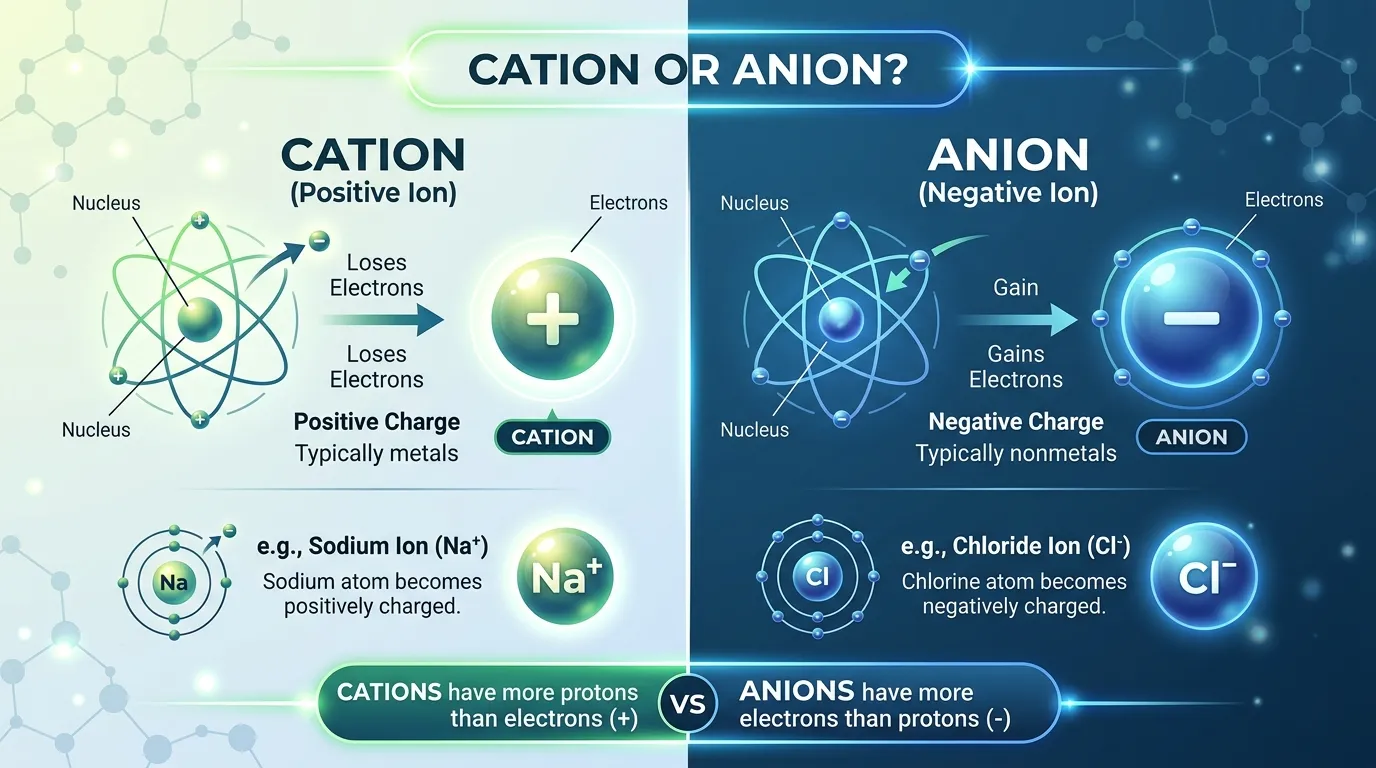
A cation is a positive ion. An anion is a negative ion. That’s the simple truth.
When an atom loses electrons, it becomes a cation. When an atom gains electrons, it becomes an anion. Think of it this way: cations are plus and anions are minus.
Here is an easy example. Sodium (Na) loses one electron. It becomes Na⁺. That is a cation. Chlorine (Cl) gains one electron. It becomes Cl⁻. That is an anion. Together, they make table salt (NaCl).
Many students mix these two up. They sound alike. They look alike. But they mean opposite things. One is positive. One is negative. Knowing the difference helps you in science class, chemistry labs, and even in reading medicine labels.
The Origin of Cation and Anion
These words come from Greek. A scientist named Michael Faraday helped create them in the 1830s. He worked with electricity and ions.
The word cation comes from the Greek word kation. It means going down. In early electricity experiments, positive ions moved down toward the negative pole. So they were called cations.
The word anion comes from the Greek word anion. It means going up. Negative ions moved up toward the positive pole. So they were called anions.
Both words have stayed the same for almost 200 years. There are no major spelling changes between old and new versions. The words are the same in science books around the world. That is why scientists from all countries can share their work easily.
British English vs American English Spelling
Good news here. The spelling of cation and anion does not change between British and American English. Both countries spell them the same way.
This is different from many other words. For example, colour in British English is color in American English. But cation and anion stay the same everywhere. Science words often do not change spelling because they need to be the same worldwide.
Here is a simple comparison table:
| Word | British English | American English |
| Cation | Cation | Cation |
| Anion | Anion | Anion |
| Ion | Ion | Ion |
| Electron | Electron | Electron |
| Positive Ion | Positive Ion | Positive Ion |
| Negative Ion | Negative Ion | Negative Ion |
As you can see, there is no difference. You can use the same spelling in the UK, USA, Canada, or Australia. No need to worry about regional spelling rules here.
Which Spelling Should You Use?
Since the spelling is the same everywhere, this question is simple. Use cation for a positive ion. Use anion for a negative ion. That rule works in every country.
If you are a student in the US, UK, India, or anywhere else, the words are the same. If you are writing a science report, a school essay, or a lab paper, use the standard spelling shown above.
If you are writing for a general audience, you can also say positive ion instead of cation. You can say negative ion instead of anion. These longer forms are easier for people who don’t study science.
For professional or academic writing, always use cation and anion. These are the correct scientific terms used in research papers and textbooks.
Common Mistakes with Cation or Anion
Many people make the same mistakes with these words. Here are the most common ones.
The biggest mistake is mixing them up. People say sodium is an anion when sodium is actually a cation. Sodium loses an electron, so it becomes positive. Positive ions are cations.
Another mistake is spelling them wrong. Some people write kation with a K. This is not correct in English. The correct spelling is cation with a C.
Some people also forget the charge. A cation always has a positive charge (+). An anion always has a negative charge (−). Forgetting this leads to wrong answers in tests.
Here is a quick memory trick. The word cation has a t in it. Think of the t as a plus sign (+) standing straight up. That reminds you: cation = positive. Anion has no t, so it is negative.
Another trick: ANion think A Negative. The AN at the start reminds you it is negative.
Cation or Anion in Everyday Examples
These words show up in more places than just science class. Here are some real examples.
In medicine, doctors talk about electrolytes. Sodium (Na⁺) and potassium (K⁺) are cations. Chloride (Cl⁻) is an anion. When you drink a sports drink, you replace these ions.
In water filters, companies use ion exchange. They remove harmful cations like lead (Pb²⁺) and replace them with safe ones. This makes water safe to drink.
In emails or reports, a scientist might write: The solution contained high levels of calcium cations. Or: Chloride anions were found in the water sample.
In social media, chemistry teachers post: Remember! CAT-ion = positive 🐱 (cats are purrr-fect, just like a + charge!)
In news articles, you might read: The battery stores energy by moving lithium cations between electrodes. This is how phone and car batteries work.
Cation or Anion Google Trends and Usage Data
The search term cation or anion is popular around the world. Students search it most during exam seasons. Countries with large student populations, like India, the USA, and the UK, show the most searches.
The term what is the difference between cation and anion is also very common. People want a clear, fast answer. They do not want long, hard explanations.
Here is a comparison table of how these words are used:
| Feature | Cation | Anion |
| Charge | Positive (+) | Negative (−) |
| Electrons | Loses electrons | Gains electrons |
| Example | Na⁺, Ca²⁺, H⁺ | Cl⁻, O²⁻, F⁻ |
| Movement in electricity | Moves to negative pole | Moves to positive pole |
| Common in | Salt, metals, batteries | Salts, acids, water |
| Memory trick | t looks like + | AN = A Negative |
Search data shows that anion is searched slightly more than cation. This may be because anion is harder to spell and remember. People also search more for anions in topics like air purifiers and water filters.
FAQs
What is the easiest way to remember cation vs anion?
Think of the t in cation as a plus (+) sign. Cation = positive. Anion = negative. Or remember: AN = A Negative.
Is sodium a cation or anion?
Sodium (Na) is a cation. It loses one electron and becomes Na⁺. The plus sign shows it is positive.
Is chlorine a cation or anion?
Chlorine (Cl) is an anion. It gains one electron and becomes Cl⁻. The minus sign shows it is negative.
Do cations and anions attract each other?
Yes! Opposite charges attract. Cations (positive) and anions (negative) pull toward each other. This is how ionic bonds form. Table salt is a great example.
Is oxygen a cation or anion?
Oxygen is usually an anion. It gains two electrons to become O²⁻. This is called the oxide ion.
Are electrolytes cations or anions?
Electrolytes can be both. Sodium (Na⁺) and potassium (K⁺) are cation electrolytes. Chloride (Cl⁻) and bicarbonate (HCO₃⁻) are anion electrolytes. Your body needs both to work well.
Can an atom be both a cation and an anion?
No. An atom has one charge at a time. It is either positive (cation) or negative (anion). It cannot be both at the same time.
Conclusion
Cation and anion are two very important words in science. They are easy to mix up, but they mean opposite things. A cation is a positive ion. It loses electrons. An anion is a negative ion. It gains electrons.
The spelling is the same in British and American English. There is no need to change anything based on where you live. Just remember: cation is positive, anion is negative.
Use the memory tricks. The t in cation looks like a plus sign. AN in anion stands for A Negative. These tricks work fast and stick in your memory.
These words show up in school, medicine, water filters, batteries, and more. Knowing the difference helps you understand the world around you. It also helps you do better in science tests.
Next time you see the word cation or anion, you will know exactly what it means. Keep it simple. Cation = positive. Anion = negative. That is all you need to know.

I’m David Baldacci, a bestselling thriller author passionate about suspense, mystery, and unforgettable characters. Through Grammerliz.com, I share insights into my books, writing journey, popular series, and storytelling techniques. This platform connects readers with my latest releases, thrilling adventures, and the world of crime fiction that has inspired millions worldwide.