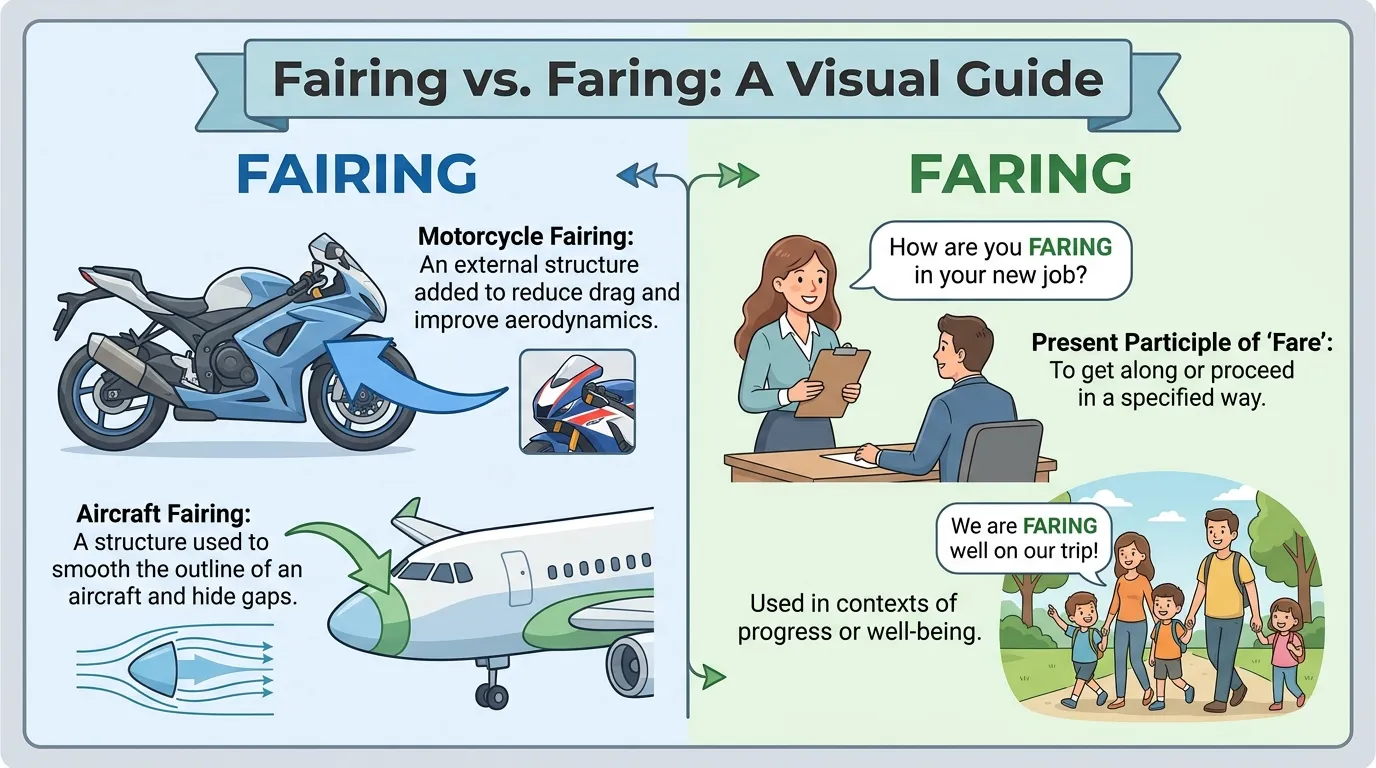
Have you ever typed fairing or faring and stopped to wonder which one is right? You are not alone. Many people mix up these two words.
They sound the same when you say them out loud. But they mean very different things.
People search for this topic because they want to write correctly. You are sending an email, writing a report, or posting online, spelling matters. The wrong word can confuse your reader.
This article clears up the confusion. You will learn what each word means. You will see examples of how to use them.
You will also find out which spelling to use in different situations. By the end, you will know exactly when to write faring and when to write fairing. Let’s make it simple and clear.
Fairing or Faring Quick Answer
Faring is the word most people need. It means how someone is doing or getting along. For example: How are you faring in your new job? That means: How are you doing in your new job?
Fairing is a different word. It is not used in everyday talk. A fairing is a shell or cover put on a vehicle. It makes the shape smooth. It helps cut through air or water. For example: The motorcycle has a fairing to reduce wind.
So if you want to ask how someone is doing, use faring. If you are talking about a smooth cover on a car, bike, or plane, use fairing. Most of the time, the word you need is faring.
The Origin of Fairing or Faring
The word faring comes from the old word fare. This word has been in the English language for over a thousand years. In Old English, faran meant to travel or to go. Over time, it also came to mean how someone is getting along or doing in life.
You can still see this old meaning in words like farewell. When you say farewell, you are wishing someone well on their journey. Faring kept this idea of moving through life or a situation.
Fairing has a different story. It comes from engineering and design. A fairing is a structure that gives a smooth shape. The word grew popular in the 1900s with cars, planes, and ships. Engineers needed a word for parts that reduced drag and wind. So fairing became a technical term.
Both words share the same sound but have very different roots and meanings.
British English vs American English Spelling
Both faring and fairing are spelled the same way in British and American English. There is no spelling difference between the two versions of English for these words. However, British and American writers use them in different settings.
American writers use faring mostly in casual and business writing. They say things like How is the team faring? British writers also use faring the same way. It is common in newspapers, emails, and everyday speech in both countries.
Fairing is a more technical word. It shows up more in engineering, racing, and design writing. You might see it in British motorsport articles or American aerospace reports.
Here is a simple comparison table to show both words side by side.
| Word | Meaning | Example Sentence | Common Use |
| Faring | How someone is doing | How are you faring? | Everyday writing, emails, news |
| Fairing | A smooth cover on a vehicle | The bike has a fairing. | Engineering, motorsport, aviation |
| Fare | To get along or do | How did you fare? | Formal and casual writing |
| Fared | Past tense of fare | She fared well. | Reports, stories, news |
Which Spelling Should You Use?
The answer is simple. Think about what you are trying to say.
If you are asking about how someone is doing, use faring. This works for all readers. It does not matter if they are in the US, UK, Canada, or Australia. How are you faring? is clear and correct everywhere.
If you are writing about vehicles, machines, or design, you might need fairing. But this word is only for technical topics. Most everyday writers will never need to use it.
For students, bloggers, and business writers, faring is almost always the right choice. If you are not sure, read your sentence out loud. Replace the word with doing. If the sentence still makes sense, use faring. For example: How are you doing? works just like How are you faring?
Common Mistakes with Fairing or Faring
Many people make the same mistakes with these words. Here are the most common ones.
The biggest mistake is using fairing when you mean faring. For example, writing How is the project fairing? is wrong. The correct sentence is How is the project faring? A fairing is a car part, not a way to describe progress.
Another mistake is using fair instead of fare. Some people write How did you fair? This is wrong. The correct sentence is How did you fare? The word fair means just or light in color. It is not the same as fare.
Some people also confuse faring with fairing in news headlines. They might write The team is fairing better. This is incorrect. The right word is faring.
A quick tip: if your sentence is about a person or a situation, use faring. If it is about a physical object, you might use fairing.
Fairing or Faring in Everyday Examples
Seeing these words in real life helps a lot. Here are some examples from different types of writing.
In an email, you might write: I hope you are faring well in your new role. This sounds polite and professional. It works in any business setting.
In a news article, a reporter might write: How is the local economy faring after the floods? This shows the word used in a formal context.
On social media, someone might post: Week two of my diet. Faring better than expected! This is casual and natural.
In formal writing, a teacher might say: Students are faring well this semester. This fits in a school report or letter.
Now for fairing: a sports writer might write: The racing team added a new fairing to the car. This is correct because it refers to a car part. You would not use this word in any of the above sentences.
Fairing or Faring Google Trends and Usage Data
Google Trends shows that faring is searched far more often than fairing. Most searches come from English-speaking countries like the US, UK, Canada, and Australia. People search for it when they are writing emails, school work, or news content.
The phrase how are you faring is very popular. It appears in news sites, business blogs, and social media posts. It is a polite and formal way to ask someone how they are doing.
Fairing gets fewer searches. Most of its searches come from people interested in motorcycles, cars, or aircraft. It is a niche technical word.
Here is a usage comparison table.
| Keyword | Most Searched In | Common Context | Search Volume |
| Faring | US, UK, Canada, Australia | Everyday and business writing | High |
| Fairing | US, UK, Germany | Engineering, motorsport, aviation | Low |
| How are you faring | US, India, UK | Formal emails and news | High |
| Fared well | US, UK | Reports, stories | Medium |
FAQs
Is it fairing well or faring well?
The correct phrase is faring well. Faring means doing well. Fairing is a car or bike part. So always write faring well when you talk about how someone is doing.
What does faring mean?
Faring means how someone is getting along or doing. It comes from the word fare, which means to travel or get along in life.
What is a fairing?
A fairing is a smooth cover put on a vehicle. It reduces wind and drag. You find fairings on motorcycles, planes, and boats.
Can fairing be used in everyday writing?
No, not usually. Fairing is a technical word. Use it only when talking about vehicle parts or engineering topics.
Is faring used in British and American English?
Yes. Both British and American writers use faring the same way. There is no spelling difference between the two.
What is the past tense of faring?
The past tense is fared. For example: She fared well in the test. Or: They fared badly in the storm.
How can I remember which word to use?
Think of it this way. If you can replace the word with doing, use faring. If you are writing about a smooth cover on a machine, use fairing.
Conclusion
The words fairing and faring look and sound alike. But they mean very different things. Faring is the word most people need. It means how someone is getting along or doing. Fairing is a technical word for a smooth cover on a vehicle.
Most of the time, the right choice is faring. Use it in emails, reports, news, and everyday writing. It works in both British and American English. It is clear, correct, and easy to understand.
Remember the simple rule. If your sentence is about a person or a situation, use faring. If it is about a machine part, use fairing. When in doubt, replace the word with doing. If it fits, faring is your answer.
Good writing starts with knowing the right word. Now you do. Use faring with confidence. Your readers will thank you.

I’m Harlan Coben, a thriller author who loves creating suspense, mystery, and unexpected twists that keep readers turning pages. On Grammerliz, I share insights about my novels, bestselling book series, writing journey, and storytelling techniques. From gripping crime mysteries to psychological thrillers, this space is where readers can explore my work, latest updates, and the world behind my stories.