Many people search for “DO or MD” when they want to become a doctor or choose a healthcare provider. The two titles look similar. Both work in hospitals, clinics, and private practices.
Both can diagnose illness, prescribe medicine, and perform treatment. Because of this, many people feel confused.
The main question is simple. What is the difference between a DO and an MD? Some people think one degree is better than the other.
Others believe they are completely different jobs. These ideas often create more confusion.
The truth is that both DOs and MDs are fully trained doctors. They attend medical school, complete residency training, and care for patients. The biggest difference is in their training approach and history.
This guide explains the meaning of DO and MD in simple language. It covers their origins, training, spelling and naming differences, common mistakes, real-world examples, and usage trends. By the end, you will know what each title means and which one may fit your needs.
DO or MD Quick Answer
A DO is a Doctor of Osteopathic Medicine. An MD is a Doctor of Medicine.
Both are licensed physicians. Both can diagnose diseases, order tests, prescribe medicine, and treat patients.
For example, if you visit a family doctor with the title MD, you can receive the same basic medical care that you would receive from a doctor with the title DO.
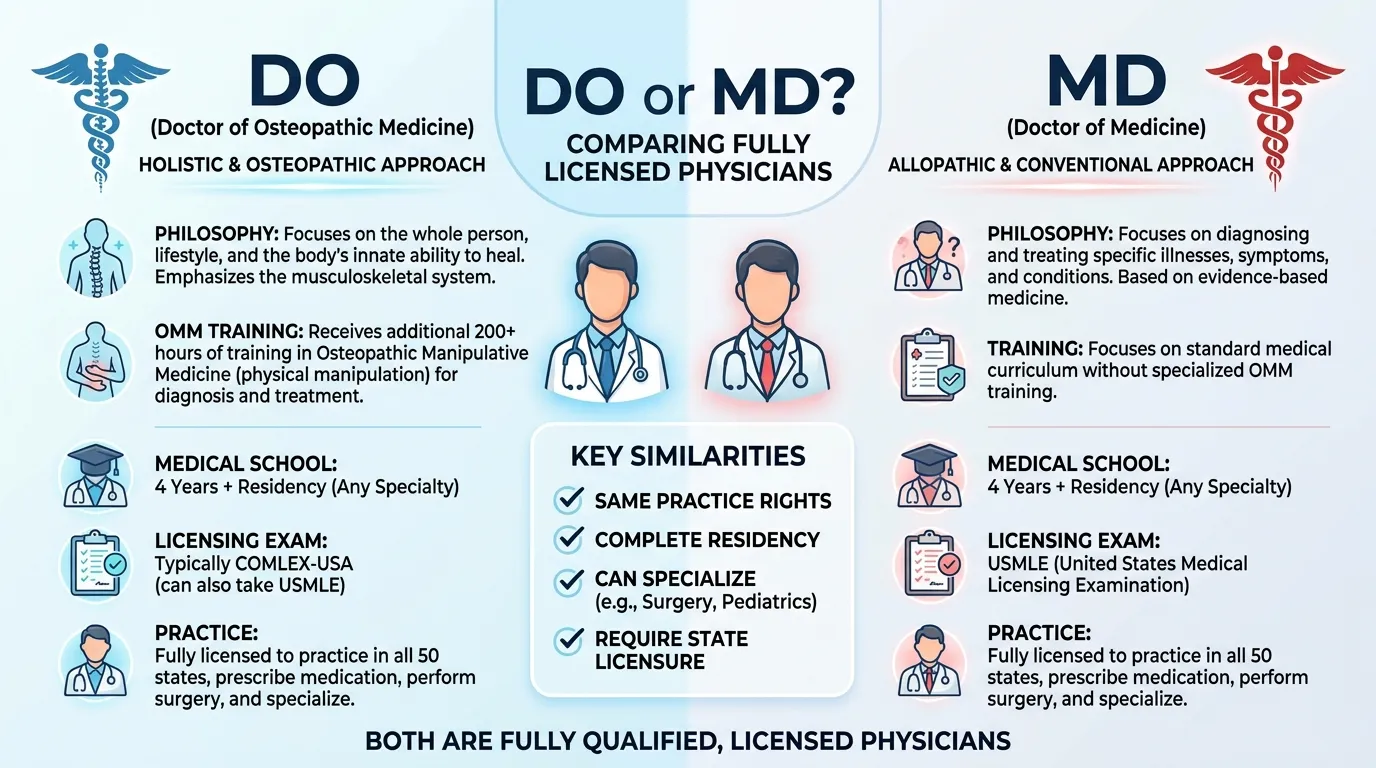
A DO often receives extra training in a whole-person approach and hands-on body techniques. An MD follows the traditional medical training path.
In daily healthcare, patients often receive similar care from both types of doctors.
The Origin of DO or MD
The MD degree has a long history. It comes from the Latin phrase “Medicinae Doctor,” which means Doctor of Medicine. This degree has been used for many centuries in many parts of the world.
The DO degree started later in the United States. It was created in the late 1800s by Dr. Andrew Taylor Still. He believed doctors should look at the whole person, not only the illness. He also promoted healthy living and preventive care.
Over time, both paths became more alike. Modern DO and MD schools teach science-based medicine. Students in both programs study anatomy, biology, disease, and patient care.
The reason different titles exist today is historical. The two systems started with different ideas, but both became accepted medical paths.
British English vs American English Spelling
The keyword “DO or MD” does not involve a spelling difference like many English words do. However, there are naming differences across countries.
In the United States, people commonly use the titles DO and MD.
In the United Kingdom and many Commonwealth countries, MD may be used differently. Medical education systems can also vary from country to country.
The titles themselves usually remain the same, but the way degrees are awarded and recognized may differ.
| United States | United Kingdom | Meaning |
| MD | MD | Doctor of Medicine |
| DO | Less common | Doctor of Osteopathic Medicine |
| Physician | Doctor | Medical professional |
| Medical School | Medical School | Place where doctors train |
The key point is that DO and MD are professional titles, not spelling variations of the same word.
Which Spelling Should You Use?
When writing about doctors, use the correct degree title.
If a doctor earned a Doctor of Osteopathic Medicine degree, use DO.
If a doctor earned a Doctor of Medicine degree, use MD.
For a United States audience, both titles are common and widely understood.
For a UK audience, MD may be more familiar because DO programs are less common.
For a global audience, it helps to explain the meaning of each title the first time you mention it.
Using the correct title shows respect and improves clarity.
Common Mistakes with DO or MD
Many people make simple mistakes when discussing DO and MD degrees.
One common mistake is thinking a DO is not a real doctor. This is incorrect. A DO is a licensed physician.
Another mistake is believing an MD is always better than a DO. Both degrees can lead to successful medical careers.
Some people think DOs only use alternative medicine. This is also incorrect. Modern DOs use standard medical treatments just like MDs.
Another error is assuming patients receive lower-quality care from one degree type. Quality depends on the doctor, training, experience, and patient needs.
Here are some common mistakes and corrections.
| Mistake | Correction |
| DO is not a doctor | DO is a licensed physician |
| MD is always better | Both can provide excellent care |
| DO uses only alternative methods | DOs use modern medicine |
| MD and DO cannot work together | They often work together |
| Patients must choose MD | Patients can choose either |
DO or MD in Everyday Examples
The terms DO and MD appear in many places.
In emails, a hospital may write that a patient has an appointment with Sarah Jones, MD.
A clinic may send a message that says Robert Smith, DO, is accepting new patients.
In news stories, reporters often mention a doctor’s title to show professional credentials.
On social media, healthcare professionals may place DO or MD after their names.
In formal writing, the title usually appears after the person’s name.
Examples include:
Jane Wilson, MD, spoke about heart health during the event.
Michael Brown, DO, discussed healthy lifestyle choices in the interview.
These titles help readers understand a doctor’s educational background.
DO or MD Google Trends & Usage Data
Search interest for “DO or MD” is strongest in the United States. This is because both degree paths are widely available there.
Students often search the keyword when applying to medical school. Patients also search it when choosing a doctor.
Interest usually increases during medical school application periods. Many future doctors want to compare training programs before making a decision.
The MD title remains more widely recognized around the world because it has existed for a longer time in many countries.
The DO title continues to grow in popularity, especially in the United States. More medical schools now offer osteopathic training, and more students choose this path each year.
People usually search “DO or MD” because they want a quick answer about differences, career options, or patient care.
DO and MD Comparison Table
| Feature | DO | MD |
| Full Name | Doctor of Osteopathic Medicine | Doctor of Medicine |
| Medical License | Yes | Yes |
| Prescribe Medicine | Yes | Yes |
| Diagnose Illness | Yes | Yes |
| Medical School | Yes | Yes |
| Residency Training | Yes | Yes |
| Whole-Person Focus | Strong emphasis | Included but less emphasized |
| Hands-On Body Techniques | Additional training | Usually not required |
| Common in USA | Yes | Yes |
| Recognized Physician | Yes | Yes |
FAQs
What does DO mean?
DO stands for Doctor of Osteopathic Medicine. It is a medical degree earned by licensed physicians.
What does MD mean?
MD stands for Doctor of Medicine. It is one of the most common medical degrees in the world.
Is a DO a real doctor?
Yes. A DO is a fully licensed doctor who can diagnose illness, prescribe medicine, and provide treatment.
Is a DO better than an MD?
Neither degree is automatically better. The quality of care depends on the individual doctor and their experience.
Can a DO perform surgery?
Yes. Qualified DOs can enter surgical specialties and perform surgery after proper training.
Do hospitals hire both DOs and MDs?
Yes. Hospitals, clinics, and healthcare systems employ both DOs and MDs.
Which degree is more common?
MD is more common worldwide. DO is especially common in the United States and continues to grow.
Should patients choose a DO or an MD?
Patients should choose a doctor they trust. Both DOs and MDs can provide excellent medical care.
Conclusion
The question “DO or MD” is common because many people want to understand the difference between these two medical degrees. While the titles are different, both represent highly trained physicians who can diagnose illness, prescribe medicine, and care for patients.
The MD degree has a longer global history and is recognized in many countries. The DO degree began in the United States and includes extra focus on whole-person care and preventive health. Today, both paths use modern medical science and require extensive education and training.
For patients, the most important factor is not the letters after a doctor’s name. Experience, communication, skill, and trust matter far more. A great DO and a great MD can both provide excellent healthcare.
For students considering medical school, the choice depends on personal goals, learning style, and career interests. Both degrees can lead to rewarding careers in medicine.
Understanding the difference helps remove confusion and allows people to make informed decisions about healthcare and medical education.